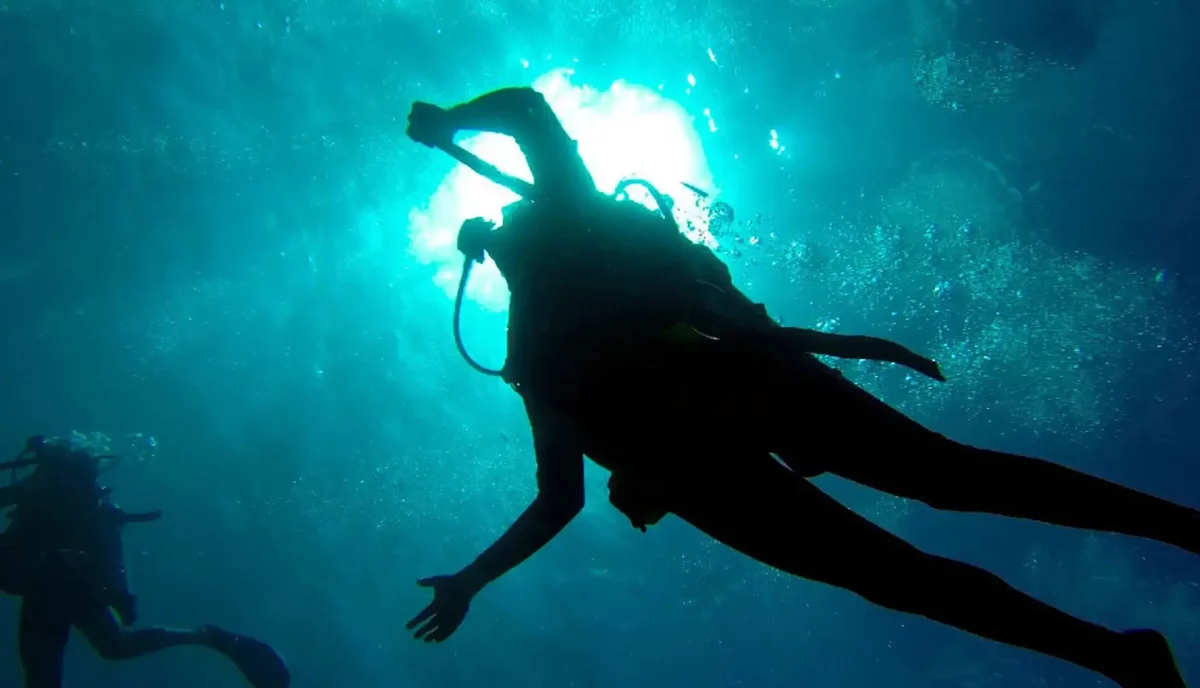
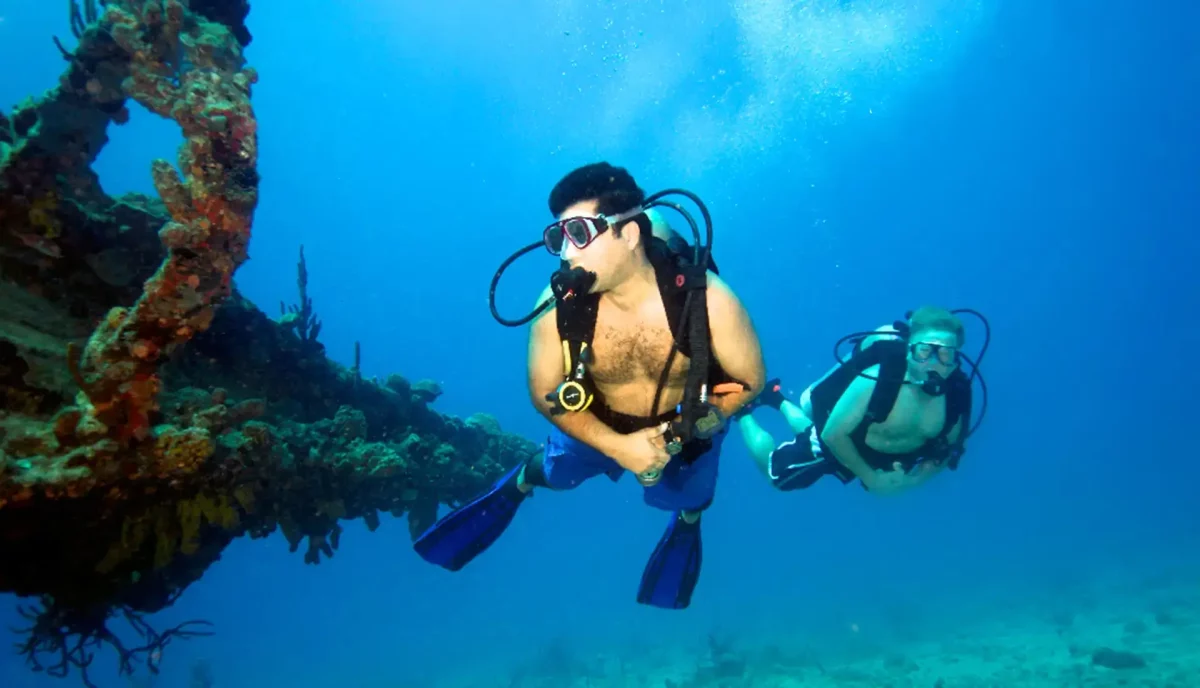

Scuba diving in the BVI is unlike anywhere else in the Caribbean. More than 60 islands, cays, and rocks scattered across some of the clearest water in the world — and beneath the surface, hundreds of dive sites ranging from shallow sand reefs perfect for first-timers to historic wrecks that have drawn serious divers from around the world for decades.
We have dived these waters extensively — our team holds PADI and NAUI certifications across Instructor and Divemaster levels, and we have logged well upward of 5,000 dives off charter yachts in the BVI and Caribbean. This guide covers everything a diver needs to know before booking a charter: the water conditions, how diving is structured onboard, your certification options, how to handle gear, and what to expect at the sites.
Whether you want to build an entire week around diving or simply add a dive or two to an otherwise relaxed yacht vacation, the BVI delivers.


Why the BVI for Scuba Diving?
The conditions in the British Virgin Islands are about as diver-friendly as it gets.
Water temperatures run around 85°F in summer and the high 70s in winter, which means wetsuits are optional for most visitors — a rash guard is often all you need. Visibility is consistently excellent, commonly 60–80 feet, and the protected anchorages throughout the Sir Francis Drake Channel mean dive sites are accessible even when conditions elsewhere in the Caribbean are less cooperative.
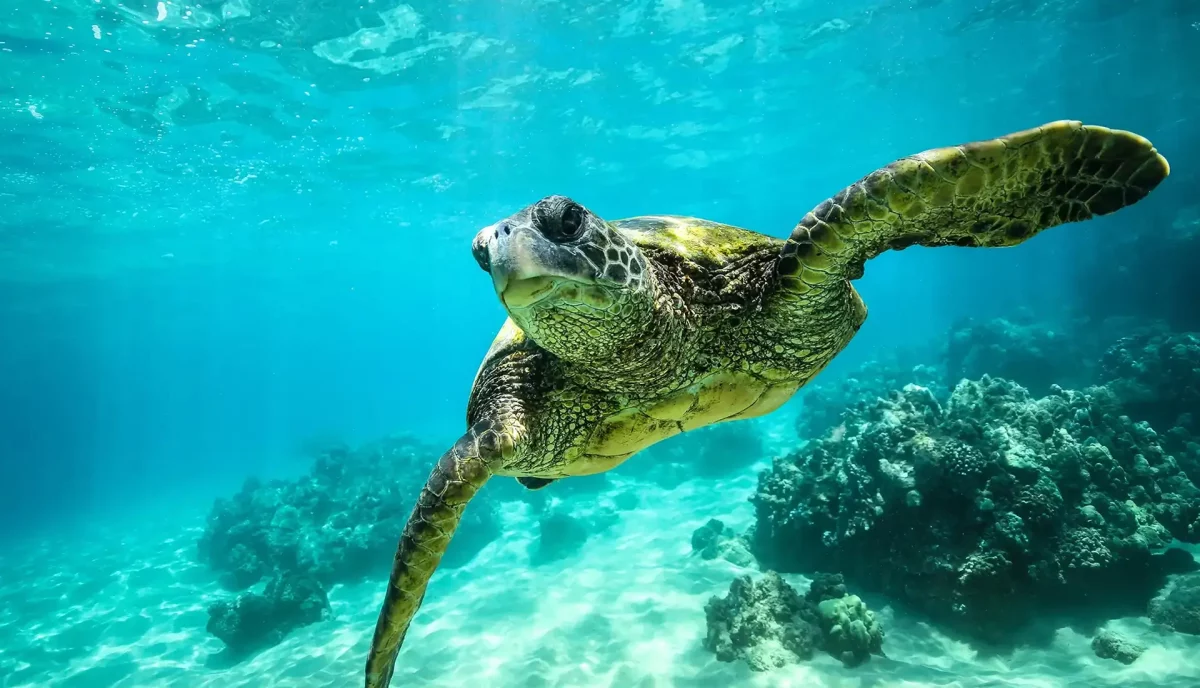
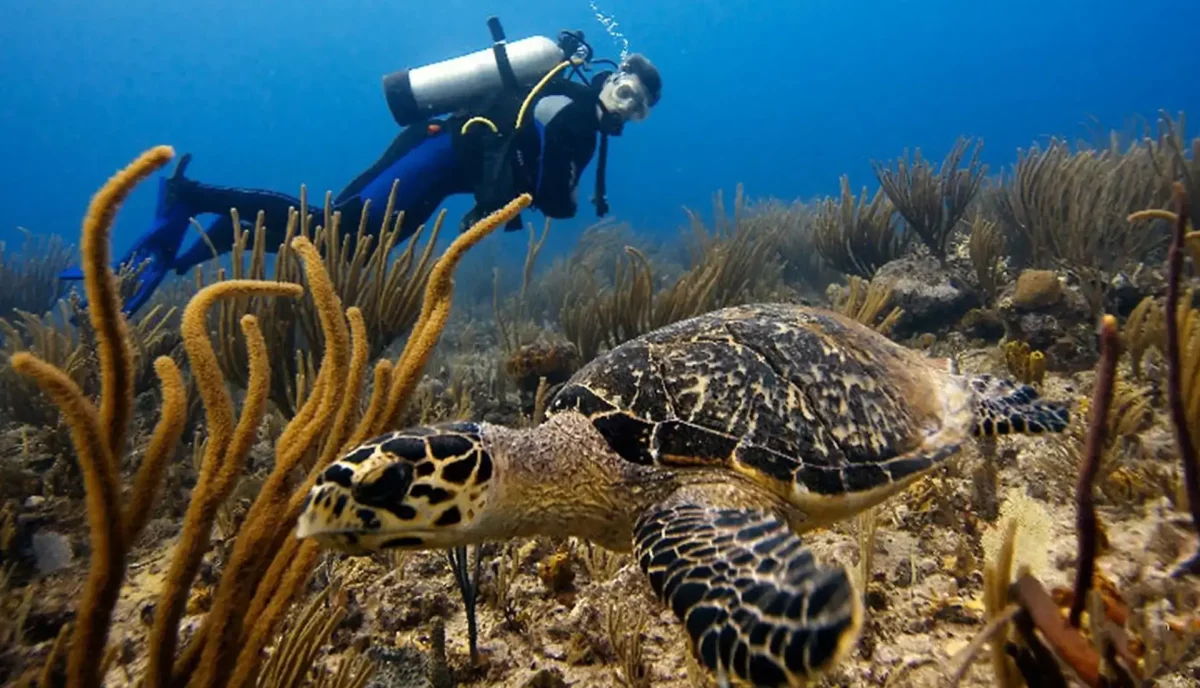
The variety is what keeps divers coming back. You have reef systems teeming with sea turtles, eagle rays, nurse sharks, and schooling fish. You have historic wrecks — the RMS Rhone is consistently ranked among the top wreck dives in the world. You have dramatic underwater topography at sites like The Indians, where four rocky pinnacles create caverns, tunnels, and walls draped in coral and fan formations. And you have remote sites like the Chikuzen off Anegada that can only be reached efficiently by yacht — which is exactly the advantage of a private charter.
Jim Scheiner’s Diving in the British Virgin Islands remains the reference for serious site exploration. You will find it on Amazon and on practically every charter yacht in the fleet.
The Advantage of Diving from a Private Charter Yacht
Dive boats and shore-based operators do excellent work in the BVI, but a private charter yacht changes the equation in several important ways.
You Reach Sites Others Can't
A charter yacht with a full week to work can reach Anegada, dive the Chikuzen in flat conditions, spend a night at anchor, and continue north — something a day-boat operator simply cannot offer. Remote sites tend to be less dived, which means better marine life and fewer crowds.
The Schedule Is Yours
On a charter, you dive when conditions are best and when your group wants to. Pre-breakfast dives are common on dedicated dive vessels. Night dives can be arranged at whatever anchorage suits the itinerary. There is no fixed departure time, no competition with other groups for mooring balls, and no rush to be back at the dock by 2pm.
Your Group Is the Only Group
Charter yachts accommodate 4–12 guests, and your party fills the entire boat. That means the divemaster’s full attention, gear staged the way your group likes it, and dive plans built around your experience levels and interests — not a mixed public boat.


Understanding Your Diving Options on Charter
Not all charter yachts offer the same level of scuba capability. Knowing the options before you book ensures your yacht matches your diving expectations.
Dedicated SCUBA Charter Yachts
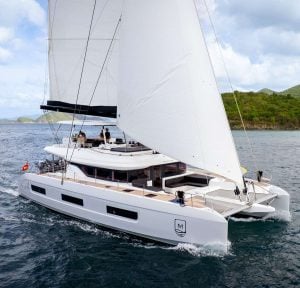
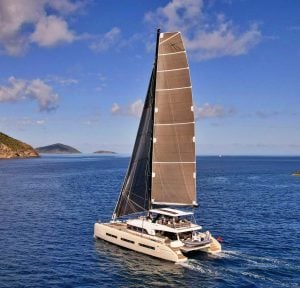
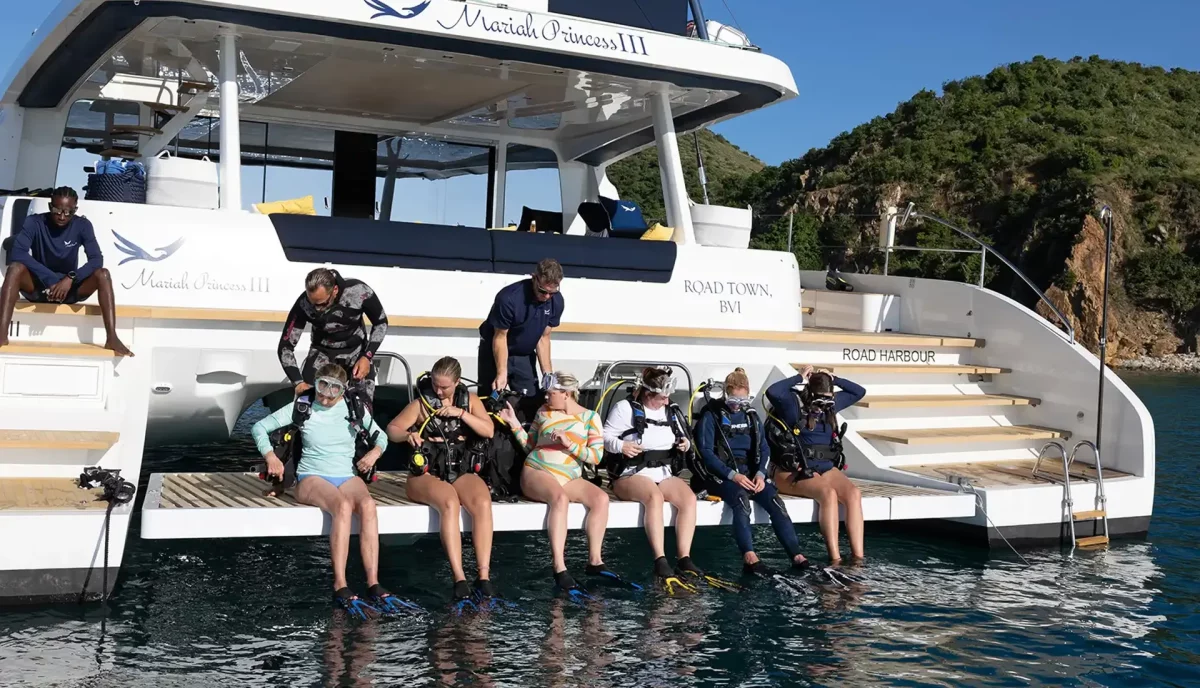
These are yachts specifically equipped and crewed for serious diving. They carry onboard compressors, multiple tanks, full rental gear, and a certified Divemaster or Instructor as part of the crew.
On a dedicated dive charter, the day is typically structured around diving: morning dive after breakfast, relocate to a comfortable anchorage for lunch, afternoon dive, then an evening at a scenic anchorage — which may also be positioned for a night dive. If you are a certified diver, many captains will allow an unsupervised pre-breakfast dive once they are comfortable with your abilities.
The honest recommendation: plan for one or two dives per day and three to five dives over the week. It sounds conservative, but if you commit to two dives per day every day, you will spend most of your charter diving, eating, or waiting — with little time for the sailing, beaches, beach bars, and everything else that makes the BVI what it is. One quality dive a day leaves room for all of it.
Casual Diving on a Standard Charter Yacht
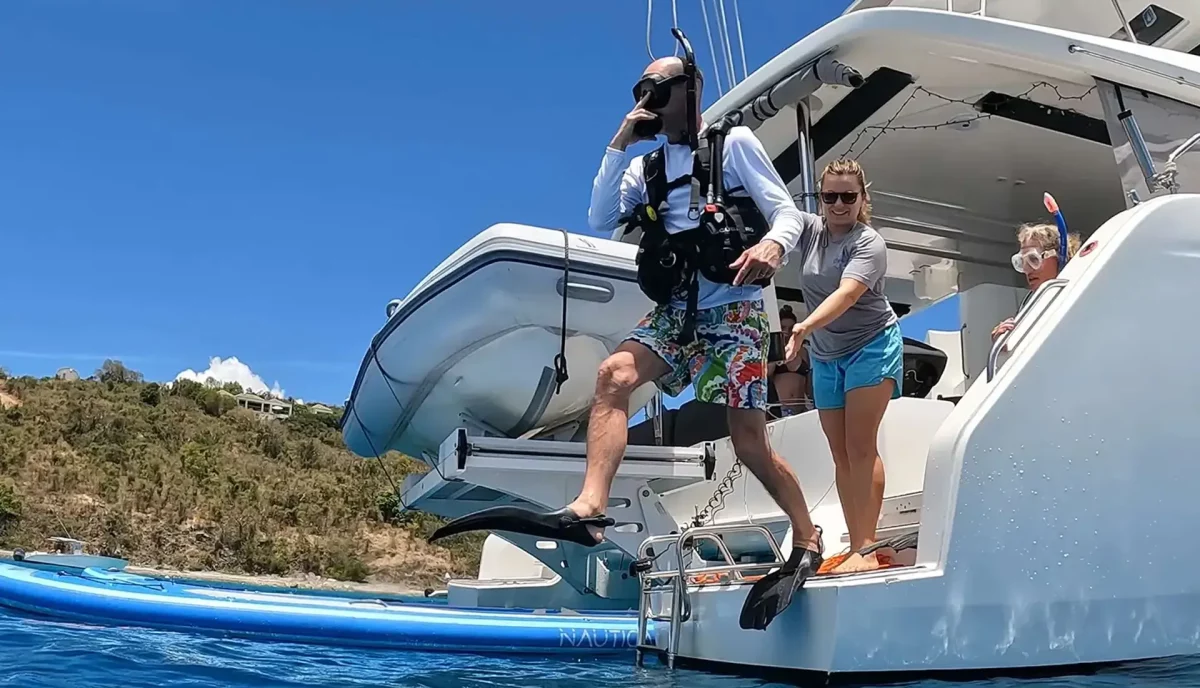
Most crewed charter yachts in the BVI can accommodate one to four dives during a week-long charter, even without onboard compressors. These boats typically carry one tank per diver, which gets refilled at a dock or beach restaurant during a lunch stop ashore. Night diving is rarely offered on this type of charter.
This is a great setup for a group with a mix of divers and non-divers. The divers get their dives in; everyone else gets beach time, kayaking, and rum punches at the Soggy Dollar. The air fill stop ashore usually turns into a lunch, a wander around a new island, and a bit of local colour — which is never a bad thing.
Casual Diving on a Standard Charter Yacht
Most crewed charter yachts in the BVI can accommodate one to four dives during a week-long charter, even without onboard compressors. These boats typically carry one tank per diver, which gets refilled at a dock or beach restaurant during a lunch stop ashore. Night diving is rarely offered on this type of charter.
This is a great setup for a group with a mix of divers and non-divers. The divers get their dives in; everyone else gets beach time, kayaking, and rum punches at the Soggy Dollar. The air fill stop ashore usually turns into a lunch, a wander around a new island, and a bit of local colour — which is never a bad thing.
Rendezvous Diving
If the yacht you have chosen does not offer scuba onboard — or if only one or two people in your group want to dive while the others prefer the beach — rendezvous diving is a clean solution.
Your captain contacts a local dive operation (Blue Water Divers, Dive BVI, and Commercial Diving are among the established operators), and a professional divemaster meets your yacht at anchor, takes your diver or divers to the site, and brings them back. The rest of the group does exactly what they want in the meantime. In many cases, the dive boat can meet you at the site itself, so non-divers can snorkel the same location and watch the divers below.
One benefit that often goes unmentioned: local dive professionals know their sites intimately. They know where the octopus hides, which boulder the nurse sharks favour, and what time of day the eagle rays come through. That local knowledge has real value.


Scuba Certifications and Learning to Dive
Getting Certified Onboard
Yes, you can complete your open water certification on a charter — but do it the smart way.
Complete the classroom and pool portions through your local dive shop or via the PADI eLearning system before you leave home. Your instructor signs off on the confined water work, and when you arrive in the BVI, you need only four open water dives to finish the certification. In the BVI’s warm, clear water, those four dives are a pleasure rather than a chore. No bulky wetsuit, no cold, no visibility issues — just warm Caribbean water and marine life that most pool-certified divers never get to see during training.
Doing the full certification start-to-finish aboard the yacht while the rest of your group is swimming, sailing, and socializing is difficult for everyone. The instructor’s time is split; the rest of the group waits. Front-loading the classroom work solves this.
You will need a yacht with a certified Instructor onboard (not just a Divemaster) to complete the open water qualification.
Discover Scuba and Resort Diving
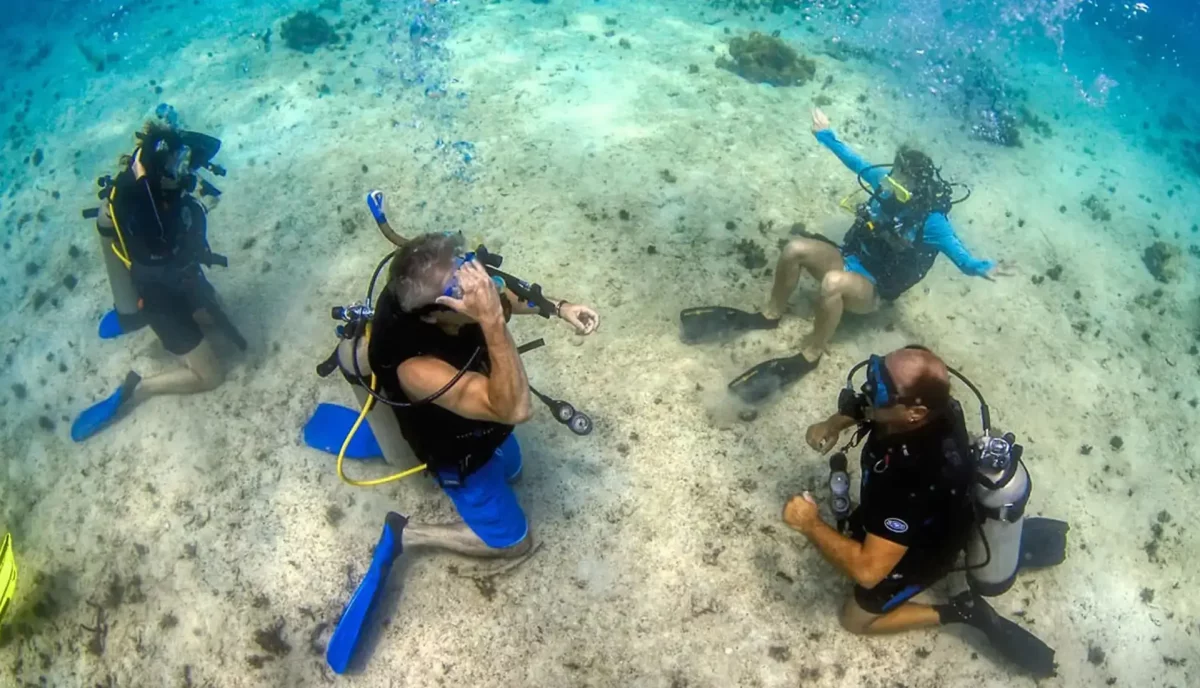
No certification? Not a problem. Discover Scuba courses — sometimes called resort dives — are available through both onboard instructors and rendezvous operators.
You get a brief orientation covering the basics: how to clear your mask, how to equalize, what the hand signals mean, and how to control your buoyancy. Then you go diving in shallow, supervised conditions. Depths are restricted, but you are genuinely in the water, genuinely underwater, seeing the reef.
This is a particularly good option for families. Children as young as ten can participate in many Discover Scuba programs, and the experience tends to be a turning point — many guests book an open water certification within a year of their first resort dive.
Certification Programs — PADI, NAUI and SSI
PADI, NAUI, and SSI certifications are all offered aboard various charter yachts in the BVI. If you are partway through a certification with a particular agency, let us know and we will match you with the right vessel and instructor.


Gear: What to Bring and What to Leave at Home
Always Bring
Your mask. Fit matters more than any other piece of gear. A mask that seals poorly for your face shape will flood constantly and turn a great dive into a frustrating one. If you have one that works for you, bring it — do not rely on rental masks.
Your dive computer. Rental computers are available but your own tracks your personal dive history, which matters for repetitive dives across multiple days.
Your regulator, if you have one. Carry it in your cabin bag, not in checked luggage. Regulators can go missing in transit, particularly through Puerto Rico connections.
Leave at Home
Pony bottles and spare air tanks. Customs and airline security will require the valve removed from any small cylinder for inspection. If the valve is attached, they may confiscate it. Unless you have a specific reason to bring your own cylinders, leave them behind — tanks are provided onboard or through the compressor service.
Full wetsuit. A 3mm shorty is fine for winter charters if you run cold. Full exposure suits are unnecessary in BVI water temperatures.
Renting Onboard or Ashore
Most dedicated scuba charter yachts carry rental BCDs, regulators, wetsuits and skins, and fins. If anything does not fit well, speak up before the dive — not after you hit the water. Dive shops on Tortola, Virgin Gorda, and other islands also offer rentals if you need to supplement what is onboard.
What You Will See Underwater
The BVI’s marine ecosystem is diverse and, in many areas, genuinely healthy. What you encounter depends on where you dive, but expect to see:
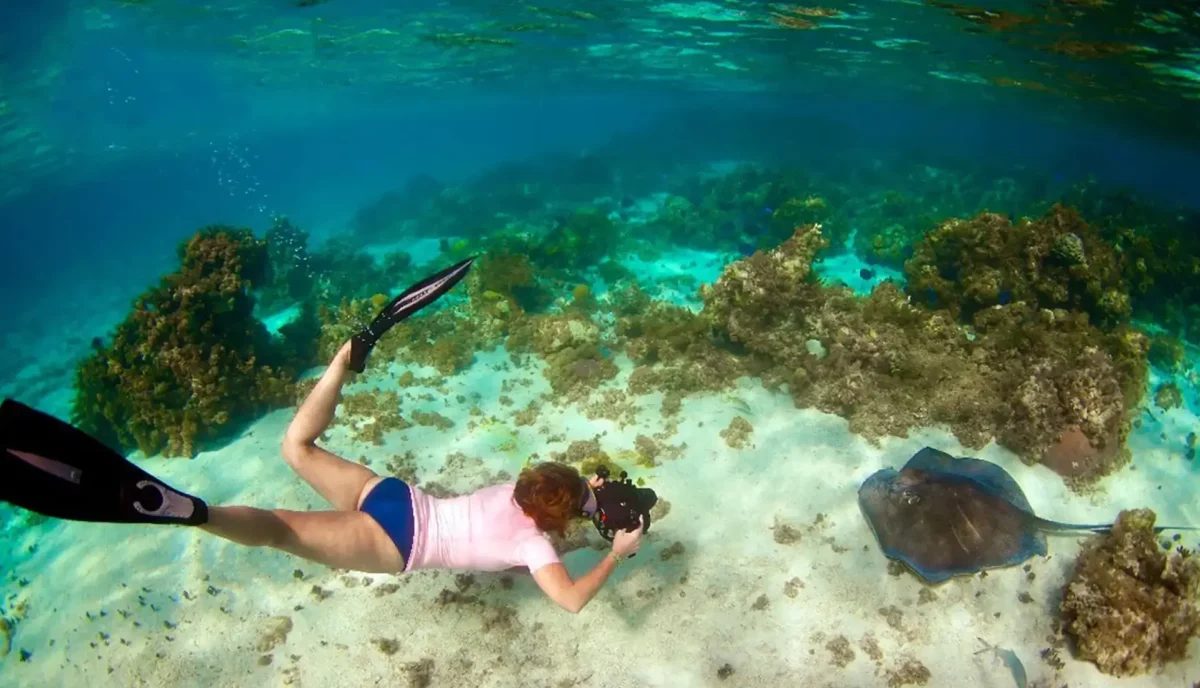
Green and hawksbill sea turtles — extremely common throughout the BVI. Eagle rays and southern stingrays. Nurse sharks resting under ledges. Large schools of tarpon and jacks. Queen and French angelfish, parrotfish, moray eels, spotted drums, and lionfish (which your captain may hunt — lionfish removal is actively encouraged throughout the Caribbean).
Slow down and look closely for flamingo tongue cowries on sea fans, cleaning stations where shrimp work on larger fish, octopus in crevices (look for the shell pile outside the entrance), Caribbean reef squid hovering at the shallows, and the occasional seahorse.
The BVI also has centuries of maritime history in the water. Underwater cannons, centuries-old glass bottles, ballast stones from old sailing ships, and the extraordinary machinery of the RMS Rhone — all accessible on a charter itinerary.


The Best Scuba Dive Sites in the BVI
The BVI has hundreds of dive sites. The following are among the most significant — from the iconic to the remote.
The Indians, Norman Island
Four rocky pinnacles rising from 50 feet below to above the surface. Coral gardens, a 15-foot swim-through tunnel, an underwater cavern, and schools of fish throughout. One of the best shallow dives in the BVI and excellent for all levels.
RMS Rhone, Salt Island
The most famous wreck dive in the Caribbean. The 310-foot Royal Mail steamer sank in a hurricane in 1867, killing 123 people. The site is now a marine park, and two dives are typically required to cover the full wreck: the deeper bow section at 75 feet, and the shallower stern with its propeller accessible at 20 feet.
Chikuzen Wreck, Anegada
A 246-foot refrigeration vessel that sank in 1981, now sitting in 75–80 feet of water surrounded by miles of sand flat. The quantity of fish life here — schooling barracuda, massive grouper, pelagics that rarely show up on reef sites — is unlike anywhere else in the BVI. Most reliably reached by charter yacht.
Painted Walls, Dead Chest Island
Four canyons with walls encrusted in corals and sponges that create a kaleidoscope of colour. Ledges and overhangs filled with cup corals and reef fish. Perfect for photographers.
Angelfish Reef
Canyons, sloping ridges, large barrel sponges along the drop-off, angelfish, triggerfish, lobster, and eels. Best worked from depth up through the smaller canyons.
The Kodiak Queen, Virgin Gorda
Sunk in 2017 as an artificial reef, the Kodiak Queen is one of the BVI’s newest dive sites. A Pearl Harbor survivor repurposed as an underwater art installation, she sits at 55 feet and is already well colonized.
Great Dog Island Airplane
The remains of a Shorts 360 aircraft that aborted takeoff in 1993. The fuselage sits in about 40 feet of sand — a compact, unusual dive that makes for a strong second dive of the day.
Rocus Wreck, Anegada
Another Anegada wreck with excellent fish life. Combined with the Chikuzen, it makes a compelling case for building a night or two at Anegada into any dedicated dive itinerary.


Planning Your Scuba Charter Itinerary
A dedicated dive week in the BVI can be built around a logical geographic circuit that naturally delivers the best sites in sequence. A common approach moves east from Tortola toward the Sir Francis Drake Channel sites (Rhone, Dead Chest, Painted Walls), works up through the Dogs and Virgin Gorda (Kodiak Queen, Great Dog airplane, Angelfish Reef), continues to Anegada for the Chikuzen and Rocus, and returns via Norman Island (The Indians, Wreck Alley) before finishing near Tortola.
Sea conditions, weather, and your group’s pace will shape the actual week. Your captain and divemaster will adjust the plan as needed — that flexibility is one of the real advantages of a private charter.
Booking the Right Charter for Your Group
Matching your group to the right vessel is the most important variable in a scuba charter vacation. We ask about the experience levels in your group, whether you have mixed divers and non-divers, what your priorities are beyond diving, and what the budget range looks like. From there we can recommend the right combination of vessel type, crew qualifications, and itinerary.
We have run scuba yacht charters in the BVI and Caribbean for nearly 20 years. Our team includes two PADI/NAUI Instructors and a Divemaster — and we have personally dived the sites we recommend. When we say the Chikuzen is worth building a day around, it is because we have been there.


Frequently Asked Questions
Do I need to bring my certification card?
Yes. Most charter yachts require proof of open water certification (or higher) before allowing dives. A photo of your card on your phone is generally accepted.
Can I dive if I haven't been in the water for several years?
Yes, but a refresher course is strongly recommended. Many dive shops in the BVI and aboard some charter yachts offer a short skills review session that gets you comfortable again before you head to a real site.
Are there age restrictions for scuba diving?
PADI open water certification is available from age 10 (Junior Open Water). Discover Scuba programs typically start at 8 or 10 depending on the operator. Check with us and we will confirm the policy for the specific yacht you are considering.
Is diving included in the charter rate?
On dedicated scuba charter yachts, diving is typically included for certified divers — tanks, weights, and divemaster guidance as part of the charter package. Gear rental is usually extra. On non-dedicated yachts with onboard tanks, a per-dive fee often applies. Rendezvous diving is always additional and priced by the dive operator.
What about flying after diving?
The standard recommendation is a minimum 12-hour surface interval before flying after a single dive, and 18 hours after multiple dives over multiple days. We can help structure your final day’s diving to give you adequate surface time before a morning departure flight.
Can we dive at night?
Night dives are available on dedicated scuba charter yachts and with some rendezvous operators. The BVI is excellent for night diving — octopus, lobster, sleeping parrotfish, and the occasional spotted moray hunting on the reef. Ask us and we will find a vessel with the right capability and crew.
Kerry Hucul is a yacht charter specialist of Epic Yacht Charters and a PADI/NAUI certified Instructor with more than 5,000 dives logged in the British Virgin Islands, Caribbean, North America, and Galapagos. Every scuba charter yacht in the Epic fleet has been personally reviewed.